Architecture · Retrospective
A blessing wall: three kiosks feeding one LED animation
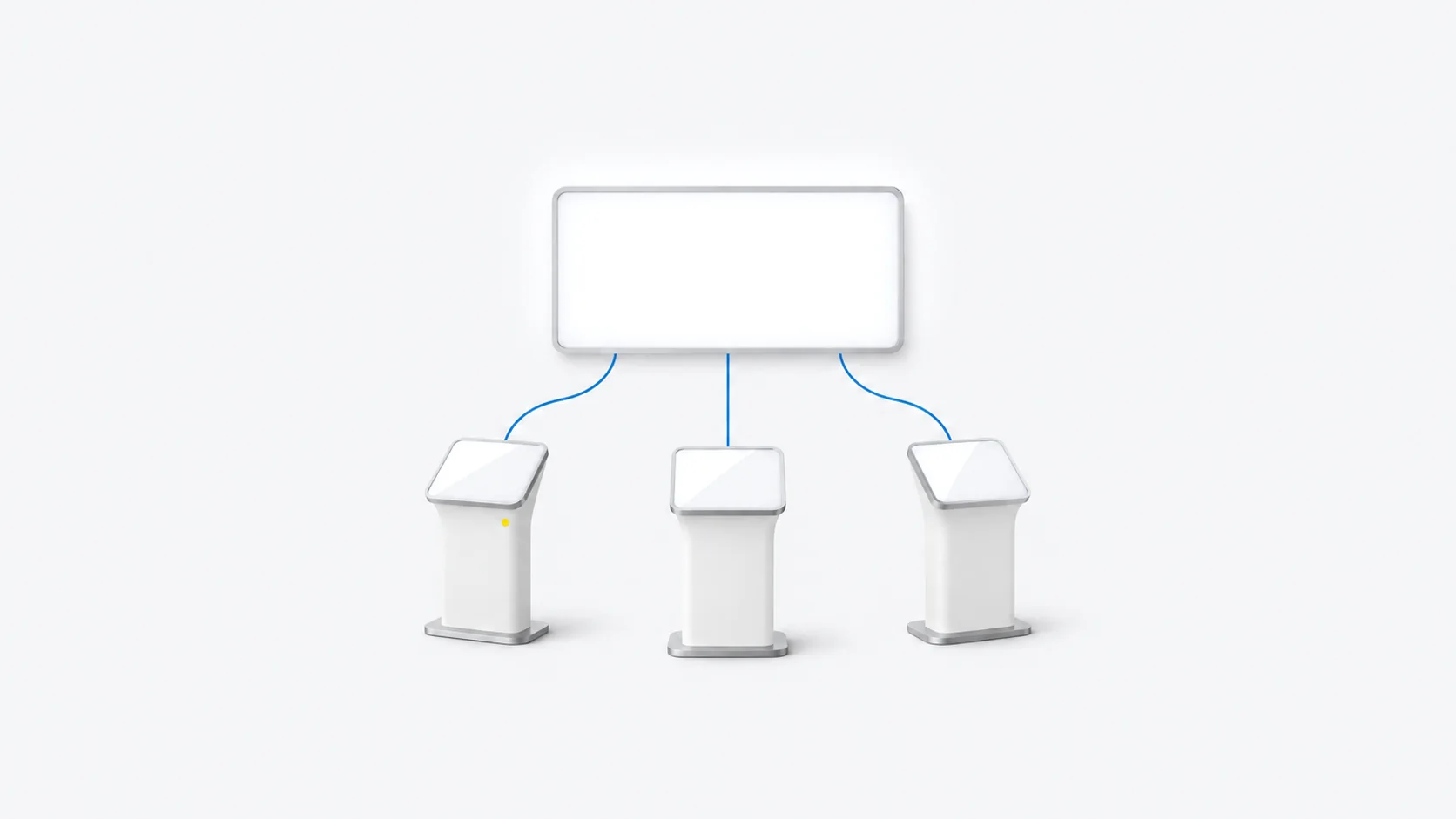
On 5 and 6 September, Bodhi Meditation PJ in Petaling Jaya held its 2025 Ullambana ceremony. Ullambana is when families dedicate merit to parents and ancestors who have died, and pray for the health and peace of those still living. Among the activities the temple listed for the two days was a Ksitigarbha blessing wall. It was an LED wall running an animation, with three kiosks where visitors write a wish. The animation and the wish-writing flow were my contribution, given pro bono.
The ceremony ran from 10 am to 8 pm on the Friday and from 10 am to 4 pm on the Saturday. That is sixteen hours of ceremony across two days, and a system that is part of it gets one chance to work.
This post is about the shape of that system, and the questions any build like it has to answer.
Many writers, one reader
Architecturally it is small: three places where wishes are written, and one place where they are shown. That shape, many producers feeding one consumer, turns up in far larger systems, and it raises the same questions at any size.
The first is order. Wishes from three kiosks arrive at one wall, and the wall has to decide what to show next. The simplest fair rule is arrival order: whoever finished writing first is carried first. It is also the easiest rule to explain to someone standing in front of the wall, waiting for their own wish.
The second is that nothing should be lost or shown twice. A kiosk that does not hear back from the wall will be tempted to send again. If it does, the wall has to recognise the repeat. Giving each wish its own identity at the kiosk, before it is sent, is what makes a retry harmless.
The third is pace. People do not arrive at an even rate. A queue between the kiosks and the wall lets the animation take wishes at the speed it can show them well, not at the speed people finish writing. When nobody is writing, the wall still has to look alive. When several people finish at once, it must not stutter.
Designing for people who will use it once
Nobody comes to a ceremony to learn an interface. Most visitors will meet a kiosk once, briefly, and then move on to the rest of the day. That changes what good design means.
A kiosk for a single use has to make three things obvious: where to start, how to start again, and that the wish has been received. The third matters most. A person who has written something personal and sees nothing happen will either walk away unsure or write it all again. Seeing the wish arrive on the wall, carried by the animation, is the confirmation. It is also the reason the wall exists.
Then there is the question of what a wish is. People write for their families, and at this ceremony some of those family members are no longer living. A wall in a hall is public. Whatever appears there should appear in the way the writer expects when they confirm, and what a visitor writes should not be kept or reused for anything beyond the purpose they wrote it for.
No second chance
Software for a company can usually be fixed next week. A ceremony cannot be moved because a screen froze, and that changes which failures matter.
The useful question is what happens when one part fails. If a kiosk stops, the other two and the wall should carry on. If the wall restarts, it should come back by itself and continue. Whatever recovery is needed has to be something a temple volunteer can do without an engineer, because on the day the people nearest the equipment are there for the ceremony, not for the technology.
Testing follows from the same constraint. A build like this is only truly tested in the hall itself, on the real screens and the real network, with people who have never seen it. The ceremony date is the deadline for that, not for the code.
The same care as paid work
The temple's post described the wall in four characters, 科技传愿: technology carrying wishes. I like the order of those words. The technology is there to carry something that belongs to someone else. If visitors notice the system rather than their wish, it is in the way.
Pro bono work is easy to treat as a side project. This one had a date that could not move, a public room, and visitors writing at a ceremony for the departed and their families. Those are reasons to build it with more care than a paid project, not less.